

Choosing the right ERP system is one of the most important technology decisions a business can make. The right system can improve visibility, reduce manual work, strengthen reporting and give teams a more connected way of working. The wrong system can create years of frustration, costly workarounds, poor user adoption and limited return on investment.
At Optimum PPS, we have supported more than 100 organisations through ERP selection, ERP implementation and digital transformation projects. Our work spans manufacturing, food and drink, distribution, engineering, charities and not-for-profit organisations. This gives us a clear view of what makes ERP selection successful.
This guide explains how to approach ERP selection in a structured, evidence-led way. It covers what ERP selection means, when to start the process, how to define requirements, how to compare vendors, what to include in an ERP RFP and how to avoid common selection mistakes. It also explains why independent ERP selection support can help leadership teams make a clearer, more confident and more defensible decision.
What is ERP selection
ERP selection is the structured process of understanding how a business needs to work, defining the people, process, data and system requirements that will support that future state, then assessing ERP vendors against clear, evidence-led criteria. The aim is to choose a solution that fits the organisation, supports users, improves control and provides a realistic foundation for long-term improvement.
A good ERP selection process should help you answer questions such as:
- What business problems are we trying to solve?
- Which processes need to change?
- What do users need from the system?
- What reporting and data improvements are required?
- Which ERP systems are genuinely suitable for our sector and level of complexity?
- Which vendor or implementation partner can support us properly?
- What will the full cost and business value look like?
- How do we make a decision that stands up to board-level scrutiny?
Why ERP selection should start before vendor demonstrations
ERP demonstrations can be valuable, but they work best when the business has already defined what it needs to test. Without detailed requirements, vendors will naturally show the strongest parts of their system. They may focus on polished dashboards, impressive functionality, sector credentials or automation features. Those areas may be relevant, but they do not always show whether the system can support the reality of your business.
Every organisation has its own processes, exceptions, reporting needs, integrations and operational pressures. A system that works well for another business may still struggle with the details that matter most to your teams.
Before reviewing ERP vendors, you need to understand:
- Where your current systems are holding the business back
- Which processes are inefficient, duplicated or too manual
- What information leadership teams need but cannot easily access
- Which teams rely on spreadsheets or workarounds
- Where data quality or integration issues create delays
- What the business needs from a future-state operating model
- What success should look like after implementation
From our experience, vendor demonstrations work best when suppliers are asked to show how their system handles real business scenarios. A generic demo may look impressive, but a scenario-led demo gives users and decision-makers a much clearer view of fit.
When should you start an ERP selection process?
Most organisations start thinking about ERP selection when their current systems can no longer support the way the business works. Common triggers include:
- Legacy systems are reaching end of life or becoming harder to support
- Teams are using too many disconnected systems
- Reporting takes too long and relies on manual effort
- Finance, operations, stock, planning or procurement teams lack one version of the truth
- Business growth has created more complexity
- Multi-site operations need more consistent processes
- Customer expectations have changed
- Current systems cannot support integration, automation or better data visibility
- Leadership teams lack confidence in the information they use to make decisions
These issues can often be managed for a while through manual effort and team knowledge. Over time, that creates risk. People spend too much time keeping processes moving, and the business becomes more dependent on workarounds.
ERP selection becomes important when the business needs a more scalable, connected and reliable way of working.
The 8 key stages of an ERP selection
A successful ERP selection process needs structure. Without it, the project can become reactive, with decisions shaped by individual preferences, supplier influence or incomplete information.
With more than 20 years’ experience supporting ERP selection, ERP implementation and digital transformation projects, Optimum PPS understands the risks that can derail system decisions, from unclear requirements and competing priorities to supplier-led demonstrations and limited internal capacity. The stages below reflect the practical approach you can use to bring clarity, control and confidence to ERP selection.
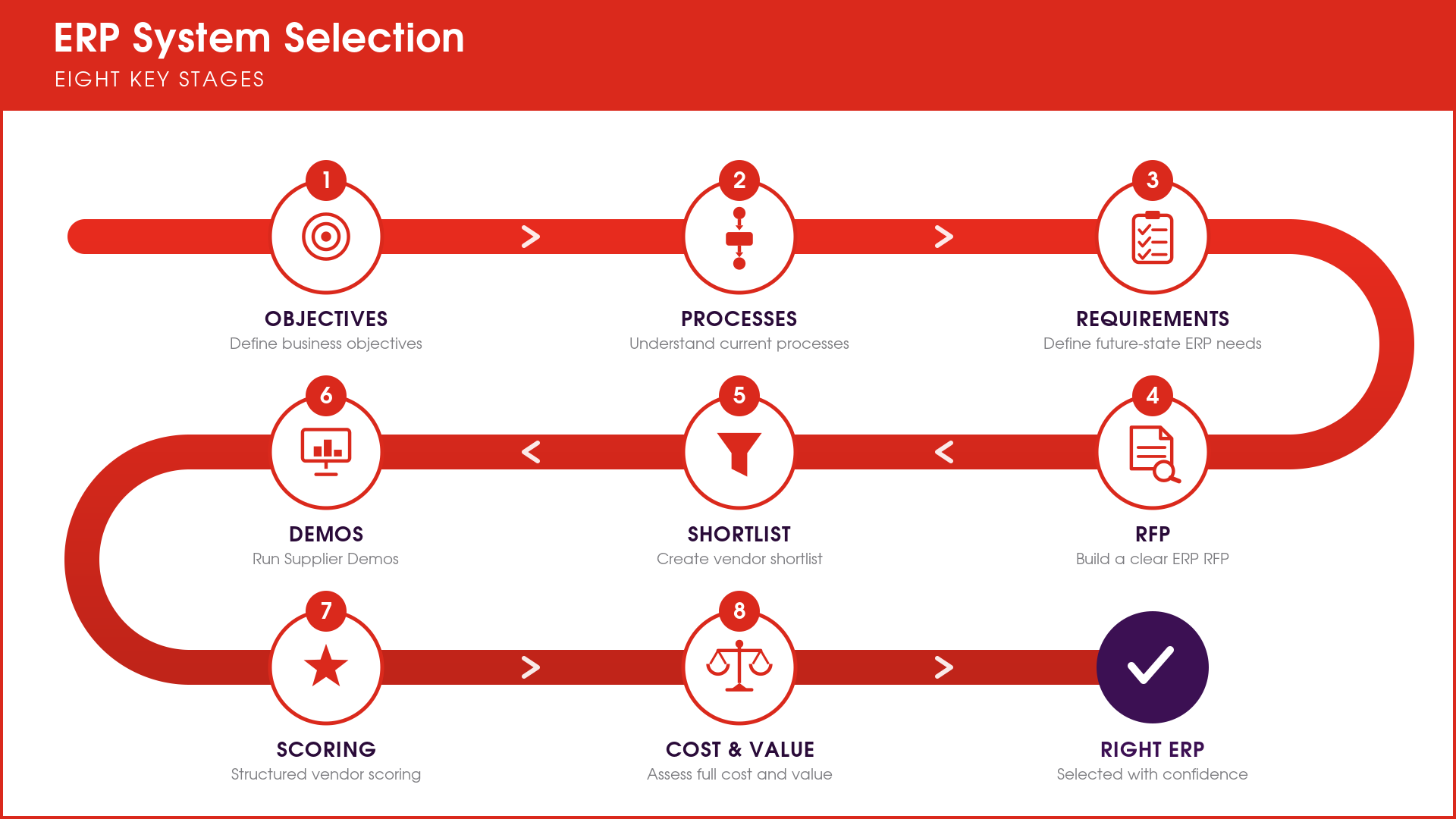
1. Define your business objectives
Start by agreeing on why the business is considering a new ERP system. Clear objectives help teams separate genuine priorities from nice-to-have features and keep the selection process focused.
These objectives may include improving visibility, reducing manual work, standardising processes, supporting growth, strengthening reporting, improving stock control, reducing risk or creating a platform for future transformation.
2. Understand your current processes
ERP selection should include a clear review of how the business works today. At Optimum PPS, we often describe this as understanding the “As Is” position. This means looking beyond documented procedures and understanding what happens in practice. Many organisations discover that teams, sites or departments have developed different ways of working, often supported by spreadsheets, manual checks or informal workarounds.
A new ERP system should support better ways of working. If the business does not understand its current processes properly, it risks carrying old frustrations into a new platform.
3. Define future-state ERP requirements
Once you understand the current state, you can define what the future needs to look like. This is where ERP requirements gathering becomes critical. High-level requirements are rarely enough. Most ERP systems can support broad needs such as finance, purchasing, stock management, planning and reporting. The real difference sits in the detail, including workflows, approvals, integrations, reporting needs, user roles and exceptions.
Optimum PPS helps clients separate genuine business requirements from the workarounds created by existing system limitations. The aim is to define what the business needs next, so the future system improves control, visibility and efficiency rather than recreating old problems.
4. Build a clear ERP RFP (Request for Proposal)
An ERP RFP, or Request for Proposal, helps suppliers understand what the business needs and gives you a consistent way to compare responses. A strong RFP should cover the business background, project objectives, current systems, functional requirements, reporting and data needs, integrations, implementation expectations, support requirements, commercial information and evaluation criteria.
The RFP should reflect your priorities, complexity and future plans. A generic checklist may create vague responses and make supplier comparison harder.
5. Create a realistic vendor shortlist
A good shortlist should include systems that can realistically support your business requirements, sector needs, scale and budget. At this stage, it is important to look beyond brand recognition. Large ERP vendors may offer broad capability, while smaller or more specialist vendors may offer stronger sector fit, faster implementation or a more focused user experience.
A realistic shortlist should consider functional fit, sector experience, implementation partner capability, integrations, reporting, scalability, support model and total cost of ownership.
6. Run structured supplier demonstrations
ERP demonstrations need structure. Without it, each vendor may present their system in a different way, which makes fair comparison difficult.
Demonstrations should be based on real business scenarios, such as quote to cash, procure to pay, stock management, month-end reporting, customer order management, multi-site planning or exception handling.
This helps users and decision-makers assess how each system would support the way the business actually works.
7. Use a structured scoring methodology for ERP vendors
ERP selection decisions should never rely on gut feel. Stakeholder views matter, but they need to be captured through a clear and consistent scoring model.
Scoring should reflect agreed priorities such as business fit, functional fit, sector experience, user experience, reporting, integration capability, implementation approach, support model and cost.
Consistent scoring gives the project team a stronger evidence base and helps leadership teams understand why one supplier has been recommended over another.
8. Assess the full cost and value of ERP
Cost will always matter, but ERP selection should focus on full cost of ownership rather than upfront software price. The full cost can include software subscriptions, implementation partner fees, internal project resource, data migration, integrations, reporting development, testing, training, change management, support and future enhancements.
A sound ERP investment decision should look at the balance of value, risk and business fit over time. The right system should support the way your organisation works and provide a practical platform for future improvement.
ERP selection considerations by sector
ERP selection should reflect the way your organisation works. A generic checklist may cover broad functionality, but it can miss the details that matter in specific sectors.
Manufacturers
- The process may need to test production planning, stock control, scheduling, quality, traceability and multi-site reporting.
Food & Drink Businesses
- Requirements often include batch traceability, allergens, expiry dates, demand planning, production scheduling and compliance.
Distribution & Trade Supply Businesses
- The focus may sit around stock availability, warehouse operations, purchasing, pricing, rebates, supplier performance and margin visibility.
Engineering Businesses
- Engineering businesses often require ERP systems that can manage complexity across project costing, estimating, materials planning, job management, design-to-production processes, quality control, supplier management and reporting, especially where work is bespoke or project-led.
Charities & Not-for-Profit Organisations
- For charities and non-profits, system selection should reflect funding, governance and service delivery requirements, as well as finance reporting, CRM, HR, case management, trustee reporting and service delivery data.
The right ERP selection process should reflect these differences from the start. That is why Optimum PPS tailors its approach to each specific client and sector, rather than applying a generic system checklist.
Common ERP selection mistakes to avoid
ERP selection is a major decision, and many common problems can be traced back to the early stages of the project. When requirements are unclear, processes are poorly understood or vendors are compared inconsistently, the business increases the risk of choosing a system that looks right but fails to deliver in practice.
Common mistakes include:
- Starting with vendors before defining requirements
- Relying on generic requirement lists
- Choosing a system because a competitor uses it
- Letting one department dominate the decision
- Focusing too much on features and not enough on process fit
- Underestimating data migration
- Ignoring integration complexity
- Comparing suppliers without structured scoring
- Overlooking user experience
- Failing to involve the people who will use the system every day
- Choosing software without understanding implementation risk
These mistakes are avoidable when the selection process is structured properly. By defining requirements clearly, scoring vendors consistently and challenging assumptions early, organisations can reduce the risk of choosing a system that looks strong in selection but fails to support the business in practice.
Why independent ERP selection matters
ERP vendors and implementation partners have valuable knowledge, but they also have a commercial interest in the outcome. An impartial view can help the business compare options more objectively, challenge assumptions and make a final decision based on fit, value and risk.
This external perspective is especially valuable when the selection process becomes complex. Different departments may have competing priorities. Suppliers may present similar capabilities in different ways. Internal teams may also be trying to manage requirements, RFPs, demonstrations, scoring and stakeholder engagement alongside their day-to-day responsibilities.
An independent ERP consultant can bring structure, pace and control to the process. This helps senior teams and key users stay focused on running the business, while the selection project continues to move forward with clear governance, consistent evaluation and proper challenge.
How Optimum PPS supports ERP selection
At Optimum PPS, we are vendor-agnostic. We do not have software vendor ties, and we do not push one system over another. Our role is to help clients make the right decision for their business.
We support ERP selection by helping organisations make confident, evidence-led decisions. Our role is to bring structure, challenge and clarity to a process that can otherwise become complex very quickly. We help clients understand what they need, why they need it and which solution is most likely to support their future way of working.
Our approach focuses on people, processes and systems because successful ERP selection depends on all three. A system may be technically capable, but it still needs to support real users, fit operational processes, provide reliable data and create value for the wider business.
Our expert ERP selection support includes:
- Discovery and stakeholder engagement
- Current-state process review
- Pain point analysis
- Future-state process definition
- ERP requirements gathering
- ERP RFP development
- Supplier market review
- Vendor shortlisting
- Demonstration planning
- Scenario-based evaluation
- Scoring and decision support
- Business case input
- Implementation planning and support
Our experience spans a wide range of sectors, project types and system landscapes, from focused ERP system selection projects through to complex ERP implementations and wider digital transformation programmes.
We have worked with organisations such as Finsbury Food Group, CEDO, Growtivation, RoSPA and Canal & River Trust. Each project has its own context, but the same principle applies: the right system needs to fit the organisation, support its people and provide a platform for long-term improvement.
Summary
How to choose the right ERP system?
The strongest ERP selection projects begin with a clear understanding of the business, including how people work, where processes create friction, where systems limit visibility and what the future solution needs to support.
A structured ERP selection process helps organisations move from uncertainty to evidence-led decision-making. It gives leadership teams a clear view of business objectives, current pain points, future requirements, vendor suitability, full cost of ownership and implementation risk.
The right ERP system should do more than meet a list of features. It should support the way your organisation needs to work, improve control and visibility, reduce unnecessary complexity and provide a practical foundation for future growth and improvement.
If you are reviewing ERP options or planning a system selection project, Optimum PPS can help you bring clarity, structure and independence to the process. Book a 30-minute selection scoping call today.
FAQs
What is ERP selection?
ERP selection is the process of defining business requirements, reviewing suitable ERP systems, evaluating vendors and choosing the solution that best fits an organisation’s processes, people, data and long-term goals.
How do you choose the right ERP system?
To choose the right ERP system, start by defining your business objectives, reviewing current processes, gathering detailed requirements, creating an RFP, shortlisting suitable vendors, running structured demonstrations and scoring each option against agreed criteria.
Why use an independent ERP consultant?
An independent ERP consultant gives objective advice without software vendor bias. They help the business define requirements, compare systems fairly, challenge assumptions and choose a solution based on business fit, value and implementation risk.
What is an ERP RFP?
An ERP RFP, or Request for Proposal, is a document sent to potential ERP vendors. It explains the business requirements, project objectives, current systems, evaluation criteria and information needed from each supplier.
How long does ERP selection take?
The length of an ERP selection process depends on the size and complexity of the organisation. A focused process may take a few months, while larger or more complex businesses may need longer to complete discovery, requirements gathering, vendor evaluation and decision-making properly.
What are the biggest ERP selection mistakes?
The biggest ERP selection mistakes include starting with software demos too early, using generic requirements, choosing a system because competitors use it, focusing only on cost, ignoring data migration and failing to involve the people who will use the system.