

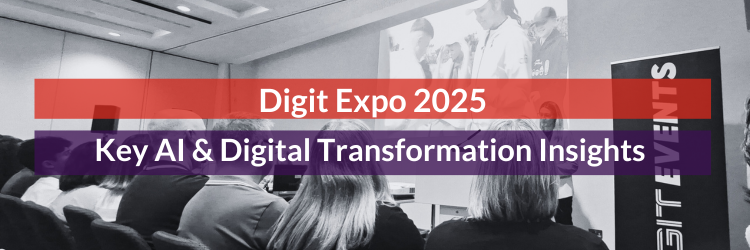
The Optimum Team recently attended DIGIT Expo Edinburgh 2025, Scotland’s largest enterprise technology event, held at the EICC. With over 1,700 attendees, 50+ speakers, and five packed stages, the event showcased cutting-edge seminars on AI, cybersecurity, and digital transformation. It was great to engage with so many industry leaders and explore what trends will shape the way businesses operate in 2026 and beyond.
In this article, we’ll share our key insights from five standout sessions featured at this year’s event.
1. Transforming Workflows: Finding Real Opportunity for AI Productivity
The session opened with a practical look at how artificial intelligence (AI), when applied strategically, can unlock genuine productivity gains for organisations. The seminar focused on practical applications that streamline repetitive tasks and reduce operational bottlenecks. Examples included automating data classification, improving content workflows and using machine learning to optimise processes that traditionally require significant manual effort.
Key Insight: Organisations should begin by mapping their workflows to identify areas where automation can add measurable value. The most successful implementations start small and scale gradually, ensuring human oversight remains central to maintain quality and compliance. AI should be viewed as an enabler rather than a replacement, complementing human expertise to create more efficient and resilient operations.
2. Beyond the Prompt: From Simple Steps to Complex Systems
Providing real-world examples from Microsoft, this seminar explored the evolution of generative AI from basic prompt-based interactions to integrated systems that deliver enterprise-level impact. The conversation highlighted that prompts are only the starting point. True transformation requires connecting AI models to structured data, business processes and governance frameworks. The future lies in systems that can reason, plan and act across multiple domains, creating intelligent workflows rather than isolated outputs.
Key Insight: Businesses need to invest in robust data strategies and governance to unlock the full potential of AI. This includes ensuring data quality, managing risk and embedding accountability into every stage of deployment. Moving beyond experimentation to structured integration will allow organisations to create scalable solutions that drive real business outcomes.
3. The Skills Shift: Preparing Workforces for Agentic AI and Co-Pilots
The panel shifted the spotlight to focus on the human side of AI adoption, highlighting how evolving roles and new technologies are reshaping workforce expectations.
As co-pilot tools and agentic AI become more prevalent, workforces must adapt to new ways of working. Roles will evolve, requiring skills such as data literacy, critical thinking and the ability to collaborate effectively with AI systems. The panel emphasised that automation does not eliminate jobs; it changes them, creating opportunities for those who embrace continuous learning.
Key Insight: Organisations should prioritise structured training programmes and foster a culture that encourages experimentation and adaptability. Preparing employees for this shift is essential to ensure technology adoption translates into sustainable business transformation. Those who invest in workforce development will be better positioned to leverage AI as a strategic advantage.
4. Driving Change: Delivering Technology Transformation at the R&A
A compelling case study from the R&A demonstrated how aligning technology initiatives with organisational vision can drive meaningful change. This session explored how the R&A, one of golf’s most respected governing bodies, changed its strategic approach to deliver technology change at scale. It emphasised that successful change is not just about implementing new systems but about aligning technology with organisational goals and embedding it into the culture. The discussion highlighted the importance of clear vision, stakeholder engagement and phased delivery to ensure transformation initiatives achieve lasting impact.
Key Insight: Technology transformation requires strong leadership and a structured roadmap. Organisations should start by defining measurable outcomes and ensuring every initiative is tied to business objectives. Communication and collaboration across departments are critical to avoid siloed efforts and maximise value. Continuous evaluation and adaptability are essential, as transformation is an ongoing process. Businesses that approach change with clarity and resilience will always be better equipped to deliver sustainable results.
5. From Breach to Recovery: Inside the West Lothian Cyber Incident
The session offered a sobering reminder of the importance of robust cybersecurity measures, drawing on lessons learned from a recent high-impact incident. In May 2025, West Lothian Council’s education network was hit by a major ransomware attack that disrupted IT systems across numerous schools and nurseries. The incident, orchestrated by a ransomware group, resulted in the theft of sensitive data and forced the council to isolate affected systems while working with police and cybersecurity experts to contain the breach and restore operations.
Key Insight: The West Lothian Council ransomware attack highlights that cyber resilience is built on preparation, rapid response, and continuous learning. The council’s ability to quickly isolate affected systems, restore data from backups, and collaborate with external experts was crucial to containing the breach and resuming operations. Cybersecurity is a continuous process that requires constant adaptation. Organisations should embed security into every layer of their digital strategy, from infrastructure to employee behaviour. Building resilience is not a one-off project but an ongoing commitment to monitoring, learning and improving in response to evolving threats.
Closing Thoughts
One of the key themes from DIGIT Expo 2025 is that technology alone does not deliver transformation. The sessions on AI productivity, generative systems, workforce skills and cyber resilience all pointed to the same underlying principle. Success depends on the ability to integrate people, processes and systems into a cohesive strategy.
Artificial intelligence can streamline workflows and unlock new efficiencies, but only when supported by clear governance and a workforce equipped to adapt. Cyber resilience requires robust technology, yet its effectiveness is dependent on well-defined processes and a culture of awareness. Even in established organisations, as demonstrated by the R&A, transformation is only possible when leadership champions change and ensures alignment across the board.
If any of the topics in this article sparked questions about your own systems or ways of working, we would be delighted to explore those with you. Get in touch today.